 Delta Issues Apology to Double Leg Amputee Veteran After Allegedly Removing Him from His Seat
 Delta claims company made it up to Marine vet with prosthetic legs after crew booted him from exit row seat
 NYC couple accused of abducting their 8 children charged with kidnapping
 Norm selected as a Super Lawyer for the NY Metro area
 In a sad and tragic case, Norm represented an individual charged with murder
 Upstate’s ‘Serial Spitter’ Dons Saliva Shield in Court
 NYPD Detective charged with pimping out a teen
 Norman Steiner fights terrorist funding in Federal Court
 Building Owner charged with manslaughter in a construction related tragedy
Hurt on Property? Win Your NY Premises Liability Claim
If you were injured on someone else’s property in New York, you may be able to recover compensation through a premises liability claim. Below, we explain what you must prove, how “notice” works, common defenses, key deadlines, and practical steps to protect your rights. Have questions now? Contact our New York premises liability team.
What Is a Premises Liability Claim in New York?
Premises liability is a negligence claim arising from unsafe conditions on property. In New York, owners and those who control property must use reasonable care to keep the premises reasonably safe and to warn about hazards they know about or should discover with reasonable care (see Basso v. Miller).
Typical cases involve slip-and-falls or trip-and-falls, falling objects, defective stairs or railings, inadequate lighting, and unsafe snow and ice conditions.
Key Elements You Must Prove
To recover, you generally must show:
- Duty: The owner or party in control owed a duty to keep the property reasonably safe.
- Breach: They created a dangerous condition or failed to correct or warn about it.
- Causation: The breach caused your accident.
- Damages: You suffered actual harm (medical bills, lost income, pain and suffering, etc.).
New York courts often focus on notice—whether the defendant created the condition, had actual notice of it, or had constructive notice because the condition existed long enough or occurred often enough that it should have been discovered (see Gordon v. American Museum of Natural History; Negri v. Stop & Shop).
Notice: The Pivot Point in Many Cases
Notice is frequently disputed. Evidence showing how long a spill, defect, or icy patch existed can be decisive. Regular inspection and cleaning practices matter. For recurring conditions—like tracked-in water at a store entrance or ice that forms under certain weather patterns—proof of repeated occurrence can help establish constructive notice.
Special Rules for Snow and Ice
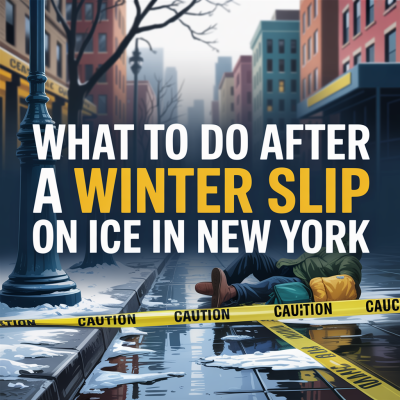
New York recognizes a “storm-in-progress” rule: property owners generally are not required to remedy snow or ice while a storm is ongoing. Liability may arise if they fail to act within a reasonable time after the storm ends, or if their removal efforts make conditions more dangerous (see, e.g., Espinal v. Melville Snow Contractors for contractor liability when snow/ice work worsens conditions).
Comparative Fault in New York
New York follows pure comparative negligence. If you are found partly at fault—for example, by not observing an open and obvious hazard—your compensation can be reduced in proportion to your share of fault, but you are not barred from recovery solely because you share some responsibility (see CPLR § 1411).
Who Can Be Held Responsible
Responsibility can extend beyond the titled owner to tenants, property managers, maintenance companies, or contractors who control the area or created the hazard. Contractors may be liable in specific circumstances, including when their work created or exacerbated a dangerous condition (see Espinal).
For municipal property or public sidewalks, special statutes and prior written notice rules may apply, and procedural requirements differ from private property claims.
Evidence That Strengthens Your Claim
- Incident and maintenance logs, inspection records, and cleaning schedules
- Surveillance video (request preservation quickly—systems often overwrite)
- Photos and measurements of the defect; lighting and weather conditions; your footwear
- Weather records and reports
- Witness statements and prior complaints or similar incidents
- Medical records and documentation of lost income
Common Defenses and How to Anticipate Them
- Lack of notice: The defendant claims they did not know and could not have known about the condition.
- Trivial or open and obvious: The defect is argued to be too trivial to be actionable or was obvious (see Trincere v. County of Suffolk on trivial defects).
- Storm in progress: A storm was ongoing at the time of the fall.
- Comparative fault: The plaintiff’s own negligence caused or contributed to the fall.
Anticipate these defenses by promptly documenting the condition, obtaining witness accounts, and investigating inspection and maintenance practices for the specific timeframe.
Deadlines and Special Notice Requirements
Time limits are strict and fact-dependent:
- General negligence: Often a three-year statute of limitations (see CPLR § 214(5)), subject to exceptions.
- Claims against municipalities: A written notice of claim is typically due within 90 days (see GML § 50-e), and the lawsuit deadline for many municipal defendants is often one year and 90 days from the event (see GML § 50-i), with exceptions.
Because these timelines are strictly enforced and exceptions may apply, speak with a New York attorney promptly to protect your rights.
What To Do After an Injury on Property
- Report the incident to the property owner or manager and ask for a copy of any incident report.
- Photograph the scene and your injuries as soon as possible, including lighting, weather, footwear, and the exact location.
- Request preservation of surveillance footage, incident reports, and maintenance logs.
- Seek medical care and follow treatment recommendations.
- Avoid detailed statements to insurance adjusters until you understand your rights.
- Consult a New York premises liability attorney to assess notice, potential defendants, and deadlines.
Quick Tips to Strengthen Your Case
- Send a preservation letter to the property owner immediately requesting video and maintenance records.
- Save the footwear and clothing you wore at the time of the incident.
- Document your symptoms daily and keep all follow-up appointments.
- Do not post about the incident on social media.
How an Attorney Can Help
An attorney can investigate the hazard and notice issues, secure evidence before it disappears, identify responsible parties (including owners, tenants, managers, and contractors), handle communications with insurers and municipalities, and build the damages case for medical costs, lost income, and pain and suffering.
Talk to a New York premises liability lawyer about your situation.
FAQs
Do I have a case if the hazard was open and obvious?
Possibly. A hazard being open and obvious may reduce recovery under comparative negligence, but it does not automatically bar a claim. The property owner’s duty of reasonable care still applies.
What if the store says it inspected the area minutes before my fall?
Inspection records help the defense, but video, witness accounts, and condition details can still establish notice or that the hazard was created by the defendant.
Can I sue the snow contractor instead of the property owner?
Sometimes. Contractors can be liable if their work created or worsened a dangerous condition or they entirely displaced the owner’s duty to maintain safety.
How long do I have to file in New York?
Many negligence claims have a three-year deadline, but claims against municipalities have shorter timelines and a 90-day notice of claim in many cases. Consult an attorney promptly.
Sources
- Basso v. Miller, 40 N.Y.2d 233 (1976)
- Gordon v. American Museum of Natural History, 67 N.Y.2d 836 (1986)
- Negri v. Stop & Shop, Inc., 65 N.Y.2d 625 (1985)
- Trincere v. County of Suffolk, 90 N.Y.2d 976 (1997)
- CPLR § 1411 (pure comparative negligence)
- CPLR § 214(5) (three-year negligence limitations period)
- GML § 50-e (notice of claim); GML § 50-i (time to sue municipalities)
- Espinal v. Melville Snow Contractors, Inc., 98 N.Y.2d 136 (2002)
Important New York–Specific Notice
This article is for general information only and is not legal advice. Reading it does not create an attorney–client relationship. Laws change, and outcomes depend on specific facts. For guidance under New York law, consult a licensed New York attorney.